MONTHLY HIGHLIGHT - OCT 2025 U.S. Reflections: Four Weeks in the U.S.
Updated: Nov 10, 2025
Thank you for reading our Newsletter!
For more timely updates and insights into our macro thoughts, we invite you to subscribe to our newsletter.


I spent about a month in the U.S. this summer, moving between New York, Ohio, and San Francisco. It was a chance to reconnect with old networks, meet new entrepreneurs, and get a sense of the country’s mood. What struck me most was the dual reality of America today—serious structural challenges on one side, but extraordinary depth in capital and talent on the other.
On the challenge side, the issues are visible everywhere. The federal budget deficit and debt levels dominate economic debate and feed into uncertainty around interest rates. Inflation remains sticky, pushing up the cost of capital and putting pressure on valuations. Tariffs and trade policy shifts are reshaping supply chains in real time, leaving many companies and investors second-guessing where to allocate. And at a social level, the drug and opioid crisis is deeply felt—it affects communities, workforce participation, and overall productivity in ways that can’t be ignored.
Yet in parallel, the strengths of the U.S. are equally undeniable:
• New York is still the heartbeat of global finance. The density of decision-makers means you can have a strategic conversation in the morning and a financing discussion in the afternoon, often with overlapping stakeholders. I met many energetic fund managers across both private and public markets. There was no shortage of ideas—AI-driven strategies in particular were everywhere—and with the U.S. stock market performing strongly this year, the level of confidence and scale in the conversations was striking.
• Ohio and the Midwest underscore the country’s industrial backbone. The capital here is conservative, but also steady and long-term oriented—qualities that matter in volatile times. At the same time, I saw how succession has become a challenge for many family-owned businesses, especially with growing global competition. That dynamic is creating attractive opportunities to consolidate profitable, high-quality companies—an area where good deals continue to emerge.
• San Francisco remains a magnet for talent in gaming, AI, and media-tech. Even with cycles and corrections, the ecosystem continues to attract global founders and investors. I was positively surprised by the streets I walked through—cleaner and with noticeably fewer homeless than before—and there was a palpable energy driven by the recent AI boom. It was the main topic of conversation everywhere, to the point where it started to feel almost bubbly.
Takeaway: My four weeks in the U.S. highlighted a country wrestling with macro and social headwinds, but also one that continues to offer something unique—unmatched capital markets and extraordinary talent density. For companies and investors alike, this tension defines both the risks and the opportunities of engaging with America today.
Personal note: What surprised me most was the contrast with Europe and Asia. Europe feels stable but stagnant; Asia feels dynamic but still building depth. The U.S., despite all of its visible problems, remains the one place where talent, capital, and ambition collide at such scale. It’s messy, volatile, and sometimes frustrating—but also still the place where new global categories are born.
Next article will be on my trips to Japan this summer.

Hyuk-Tae Kwon
Founder and CEO
Portfolio Spotlight
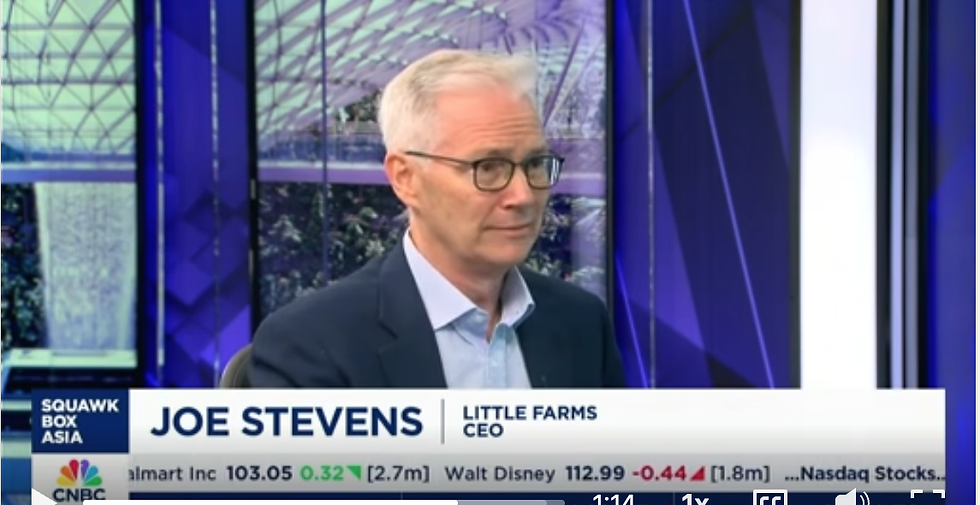
Little Farms : Joe Stevens on CNBC — announcing Whole Foods Market’s private label launch at Little Farms platforms and Amazon.sg
Where innovation meets realism - How Alchemy is improving nutritional content and reducing costs
by Investment Manager Joel Kam

With over 1 billion adults obese globally and diet-related diseases like diabetes on the rise, the urgency for healthier food solutions is clear. Yet widespread adoption often stalls when reformulated products raise costs for food providers. Alchemy began its journey on the former, but their experience (and ours as well) has set them on a journey of balancing the need for innovation as well as market realities that has got us even more excited to partner them now.
The signal from the market is clear: F&B in Singapore is struggling. Cost pressures including steep rent hikes, rising labour costs, inflation in ingredient prices and utility costs, coupled with diminishing consumer spending is challenging the longevity of F&B SMEs in Singapore. From household local dining haunts (like Ka-Soh) to brand names like Prive Group's sudden closure, the industry has been brought to the frontlines especially as people begin questioning the stability of Singapore’s position as a food haven.
Despite this, consumer awareness about health issues and the importance of eating well are increasingly prevalent. The HoReCa industry thus plays a fine balancing act between choosing better quality and healthier ingredients without being able to pass on too much of the cost to the end consumers. This leaves them stranded with few options given the already thin bottom lines on their businesses.
Alchemy has long served its purpose of being a proprietary foodtech company focused on delivering bespoke solutions to clients who are looking to improve the functional attributes of food. One of the recent projects they have begun rolling out with is a functional rice innovation with Tong Seng Produce, under the Songhe rice brand familiar to so many Singaporeans growing up. Songhe Plus, powered by Alchemy’s FibreGrain, boasts enriched dietary fibre, zinc, iron and folate that boosts immunity and the product has now been rolled out to major supermarkets across Singapore.
Beyond this, the company continues to be at the forefront of innovation in the space. Its latest innovation tackles both problems of rising ingredient costs as well as improving health outcomes. Their low-sugar instant beverages and sugar free syrups allows caterers and restaurants to save up to 60% of costs versus their competitors, while reducing the sugar content in beverages & other foods to 5% sugar or less, allowing them to obtain a Nutri-grade B and Healthier Choice certification which empowers their B2B customers to tender for government contracts in Singapore.
The powdered beverages are also operations friendly since they require little manpower and preparation time, further improving labour productivity in the sector. Till date, they are working with companies such as Guzman Y Gomez. Swensons, Four Seasons among others.
When we first invested, we were excited about Alchemy’s role in improving the adoption of functional foods and human health outcomes through better nutrition. The team however, continues to impress us with their ability to innovate and improve both health and financial outcomes, creating a win-win for all parties involved, a lesson which we will continue to expound on as we work together with them to elevate their growth as a company driven to do good and do well.
Wake me up when October ends?
by Investment Director Larry Lau
The strong run in risk assets continued, with the S&P 500 rising +3.5% for its fifth straight monthly gain, bringing the five-month cumulative return to +20.1%. Strength was led again by the Technology sector, particularly semiconductors and data-storage, alongside the broader AI theme.
Some investors argue the market has “run too far, too fast,” and we share those concerns. At ~23x forward P/E, the S&P 500 is back to dot-com era levels, tilting near-term risk-reward to the downside as positive catalysts thin out. Meanwhile, macro uncertainty ticked higher: the U.S. government announced a shutdown as I write this, adding another source of event risk.
Process over narrative remains our guide. A Citibank mentor’s advice to distil data into actionable insights feels even more relevant today in a market increasingly driven by headline-chasing speculators and quant funds chasing momentum.
Our base case: buy dips—not euphoria. The labour market is weakening, but the broader economy is still holding up (though hardly stellar). ‘Recession fear’ can spark abrupt volatility, especially if a single data release surprises to the downside. We’ll use such pullbacks as buying opportunities, as we did after the 1 August non-farm payrolls report, provided our read of the broader data is unchanged. Corporate earnings remain resilient despite tariff uncertainty, and market breadth continues to improve. We expect to increase small-cap exposure on the next pullback.
No one knows when or how deep the eventual pullback will be. “Sell in May and go away” sounds tempting given November–April’s stronger historical returns, but it would have missed the recent +20.1% gain from May to September. Since 1960, there have been 29 instances of five or more consecutive monthly gains in the S&P 500 (excluding dividends); 20 continued to rally, with the longest streak at 10 months (Apr 2017–Jan 2018). For the nine that didn’t, the average next-month loss was -2.2%.
We treat this analysis like seasonality and market analogues — the actionable insight is recognizing that it could be yet another narrative for market participants to latch on to. Our “Active-on-Active” framework rebalances to the market we have, not the one we wished we had. It led us to raise cash to ~17% on 19 September; we brought it back to 0% by last Friday, redeploying into select large-cap names that pulled back but still have durable moats and strong long-term fundamentals.
Copyright (C) 2025 Pine Capital Management. All rights reserved.
This material is provided for general information purposes only and does not take into account the specific investment objectives, financial circumstances, or particular needs of any individual. You are encouraged to consult a qualified financial adviser before making any investment decisions. Historical performance and any forward-looking statements regarding the economy, stock, bond market, economic or industry trends should not be relied upon as indicators of future results. Past performance is not indicative of future returns. Opinions expressed may change without notice and should not be interpreted as personalised advice or a recommendation. Any references to specific securities (if applicable) are for illustrative purposes only. This publication has not been reviewed by the Monetary Authority of Singapore.


