MONTHLY HIGHLIGHT - SEP 2025 Reflections from London: Tradition, Turbulence, and Transformation
Updated: Sep 9, 2025
Thank you for reading our Newsletter!
For more timely updates and insights into our macro thoughts, we invite you to subscribe to our newsletter.


Dear friends and partners,
Welcome to September edition of the Pine Capital newsletter — where we share reflections, updates, and opportunities as we grow our community and continue supporting families and founders around the world.
In mid-June, after time spent in Germany, Finland, and Sweden, I made my way to London. By the time I arrived in the UK, the contrast was striking — a country at once deeply anchored in history and yet restless to reinvent itself. London still commands a presence unlike any other. It remains one of the world’s great financial capitals, but it has also proven itself as a builder of globally relevant technology. Revolut, in under ten years, has grown into one of Europe’s most valuable companies, now generating more than £3 billion in revenue and over £1 billion in profit, with more than 50 million customers worldwide. Wise, which began as TransferWise, has matured into a public company that moves money across borders with steady profitability — reporting more than £240 million in pre-tax earnings last year. DeepMind, acquired by Google a decade ago for about $500 million, continues to shape the global AI conversation from its London base. These stories remind us that London doesn’t just attract global capital — it produces companies that can define entire categories.
At the same time, conversations with investors, families, and business owners surfaced the challenges that weigh on the UK’s outlook. The recent non-dom tax changes have already pushed many globally mobile families to reconsider their ties. Energy costs remain high and inflation persistent. Post-Brexit trade frictions and immigration constraints have left real scars, especially in industries dependent on flexible labour. And perhaps most glaring is the divide between London and the rest of the country: the capital concentrates talent, capital, and opportunity, while many regional economies struggle to keep pace.
What struck me most was the mindset. Leaders who had lived through multiple cycles — from the liberalisation of the 1980s to the 2007–08 financial crisis — were quick to point out that the real age of change lies ahead. They spoke with conviction that the next 10 to 15 years will bring more transformation, good and bad, than the last 50. Younger founders echoed that sentiment in their own way: instead of nostalgia for a “golden age,” they spoke of the opportunity to define one. In that sense, the UK felt pragmatic yet restless — pragmatic in how succession, governance, and capital are managed; restless in recognising that old systems will not carry the country forward.
For long-term investors, there is a clear lesson. The UK remains a magnet for talent and innovation, but the structural headwinds cannot be ignored. Resilience here is not about sidestepping turbulence, but leaning into it with clarity, patience, and conviction.
Looking ahead, my next stop was the United States, where I spent four weeks meeting with families, founders, and partners in New York, Ohio, and San Francisco/Bay Area. I look forward to sharing those reflections in the next newsletter.
Until then, stay tuned on our LinkedIn and YouTube, where I’ll be posting updates and short reels throughout the trip.

Hyuk-Tae Kwon
Founder and CEO
Portfolio Spotlight
Alchemy Foodtech : SCMP opinion spotlights Alchemy Foodtech’s role in shaping healthier Asian diets.
Immersive Experiences and Spatial’s Breakthrough
by CEO Hyuk-Tae Kwon & Investment Manager Joel Kam

Immersive experiences are rapidly becoming one of the next major evolutions of the internet. The global VR and gaming markets continue to expand, with growing demand for platforms that enable collaboration, creativity, and commerce in 3D environments. Spatial sits at this convergence: empowering creators, educators, brands, and enterprises to build interactive experiences across Web, mobile, and VR.
The journey has not been without challenges. Early on, VR headset adoption was slower than many anticipated, making it difficult to scale immersive platforms at the pace originally envisioned. Yet Spatial’s team remained committed, aligning around a long-term vision and continuing to invest through these cycles. That persistence ultimately paid off, enabling them to capture the right audience at the right time.
Today, the platform hosts millions of immersive experiences and is used by global enterprises and cultural leaders such as BMW, Vogue, and Absolut. Its no-code Creator Toolkit and Unity SDK lower barriers for creators, while new subscription tiers and transparent revenue-sharing empower sustainable monetisation.
A striking example of this vision is Animal Company, developed by Spatial’s Wooster Games studio. What began as a six-week hackathon has become one of the most-watched and most-played VR titles worldwide.

With over 1M monthly active users, 300K+ Discord members, and 1B+ organic TikTok views, Animal Company achieved breakout success without a single dollar spent on advertising.
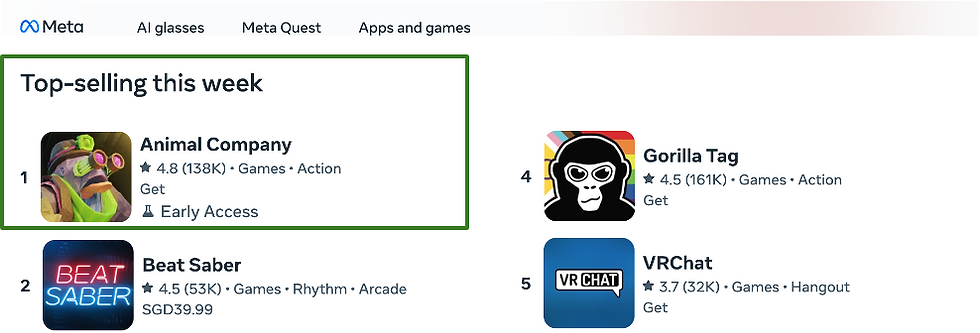
By focusing on social chaos, unpredictable interactions, and “you had to be there” moments, Wooster engineered a product that markets itself. Weekly updates and close community engagement turned it into more than a game: a cultural touchpoint and a case study in how creators and players can drive growth together.
From early headset challenges to viral gaming success, Spatial has shown adaptability, vision, and execution — proving it is not just following the evolution of immersive experiences but actively shaping the future of digital creativity.
Further reading & watching:
🐂 A Resting Bull Is Not a Bear
by Investment Director Larry Lau
Market momentum continued with the S&P 500 up +1.91% in August, setting fresh record highs during the month and marking a fourth straight monthly gain. Market breadth improved, which is a healthy development after months of narrow participation. The equal-weighted S&P 500 rose +2.72% and the small-cap Russell 2000 jumped +7%, both outpacing the cap-weighted benchmark.
Economic indicators continue to support our view that the US economy is “slowing, but not recessionary” despite occasional bouts of investor nerves. At Pine Capital, we follow an “Active-on-Active” approach, adjusting equity exposure between 70% to 100% based on Market Structure, Valuations, Sentiment and Positioning factors. Should recession become our base case, we take the lower bound down to 50%.
This active rebalancing seeks to capture alpha from the market’s over- and under-reactions in a tape increasingly driven by flows rather than fundamentals. A recent example was the negative reaction to the weaker than expected non-farm payrolls on 1 August. Having raised cash levels to ~10% the week prior, we used the weakness as an opportunity to increase portfolio exposure back to 100%. Our analysis across various labour market datasets suggested the move was most likely an overreaction. Subsequent data helped validate that view – the August US Flash PMI report noted that “service providers took on staff at the fastest pace for seven months while factory job gains reached the highest since March 2022”.
We remain mindful of the near-term risks – less on the economy and more on valuations and positioning. With the S&P 500 trading at ~22.4x 12-month forward P/E, a technically overbought backdrop (when it arrives) could trigger a pullback that surprises investors even without a recession. To be clear, we remain constructive and expect to be buyers on weakness, focusing on high-conviction holdings where fundamentals remain intact. History provides useful context on what to anticipate – Since 1980, the S&P 500’s average intra-year drawdown has been -14.1%. Even in years that finish positive, the average intra-year decline is -11.5%; in down years it deepens to -23%. Our Active-on-Active framework helps us scale exposure across market environments, trimming into crowded strength and adding into price dislocations.
This material is provided for general information purposes only and does not take into account the specific investment objectives, financial circumstances, or particular needs of any individual. You are encouraged to consult a qualified financial adviser before making any investment decisions. Historical performance and any forward-looking statements regarding the economy, stock, bond market, economic or industry trends should not be relied upon as indicators of future results. Past performance is not indicative of future returns. Opinions expressed may change without notice and should not be interpreted as personalised advice or a recommendation. Any references to specific securities (if applicable) are for illustrative purposes only. This publication has not been reviewed by the Monetary Authority of Singapore.


